The Problem
Dive supervision still runs on paper
- Checklists, wet notes, and table lookups compete for the supervisor's attention at the moment attention matters most.
- Conditions checks are manual. Someone calls Port Ops, someone checks the weather page, nothing is logged.
- Decompression math is done by hand under time pressure, including recomputes when a dive goes long or a stop is missed.
- Casualty procedures live in a binder. Diagnosis flowcharts and neuro exams are hard to run cleanly from paper on a wet deck.
- The paperwork burden lands after the dive, when details are already fading.
Supervisor signs on with name and contact number, nothing else to manage
DiveSupUnclassified
The Capability
One guided workflow, plan through debrief
- Mission library. Reusable dive plans with depth, bottom time, gas mode, and location. One tap to execute.
- Guided dive day. Assign team, check conditions, brief and equipment checks, then the dive station.
- Three sides of the house. SCUBA, MK 16 closed-circuit rebreather in nitrogen-oxygen and helium-oxygen, and a surface-supplied side covering air and mixed gas.
- Doctrine under everything. Tables and procedures carry their source: Navy Diving Manual Rev 7 Chg A and published dive medicine references.
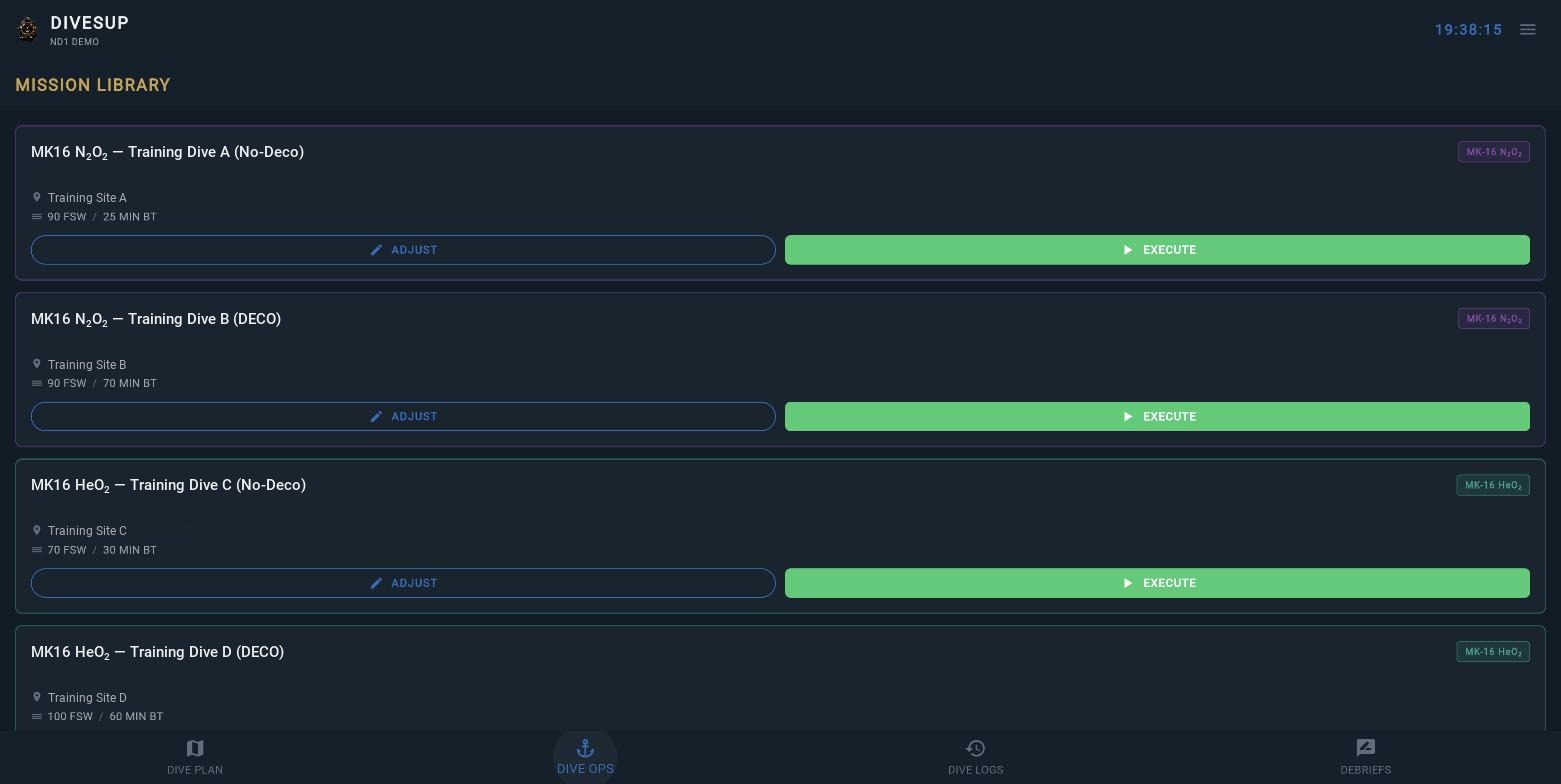
Mission library with seeded MK 16 demonstration plans
DiveSupUnclassified
Workflow
Executing a plan starts the dive day
- Step 1. Assign dive team: divers, standby, tenders.
- Step 2. Conditions check against live sources.
- Step 3. Dive brief and equipment checks.
- Step 4. Dive station, the in-water watch screen.
- The app enforces the order. Nothing in-water opens before the checks are done or the supervisor documents a bypass.
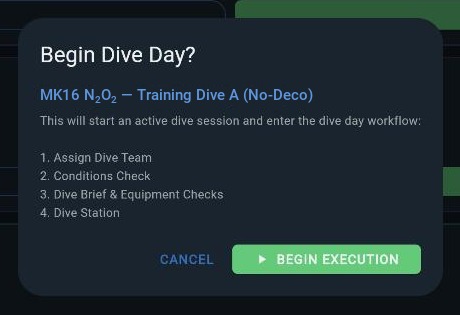
The workflow is stated up front when execution begins
DiveSupUnclassified
Feature · Dive Planning
The plan computes its own limits
- Mode first. SCUBA, MK 16 nitrogen-oxygen, or MK 16 helium-oxygen, each with its gas badges and its own table set behind it.
- Live decompression verdict. Enter depth and bottom time; the plan banner answers immediately: no decompression required, setpoint, no-decompression limit, minutes remaining, with the Navy Diving Manual table cited as authority.
- Oxygen flask endurance computed from charge pressure and air and water temperature, reserve excluded and assumptions stated.
- Carbon dioxide canister duration by absorbent type, the limiting-factor input for the brief.
- Repetitive dive support carries residual nitrogen forward into the next plan.
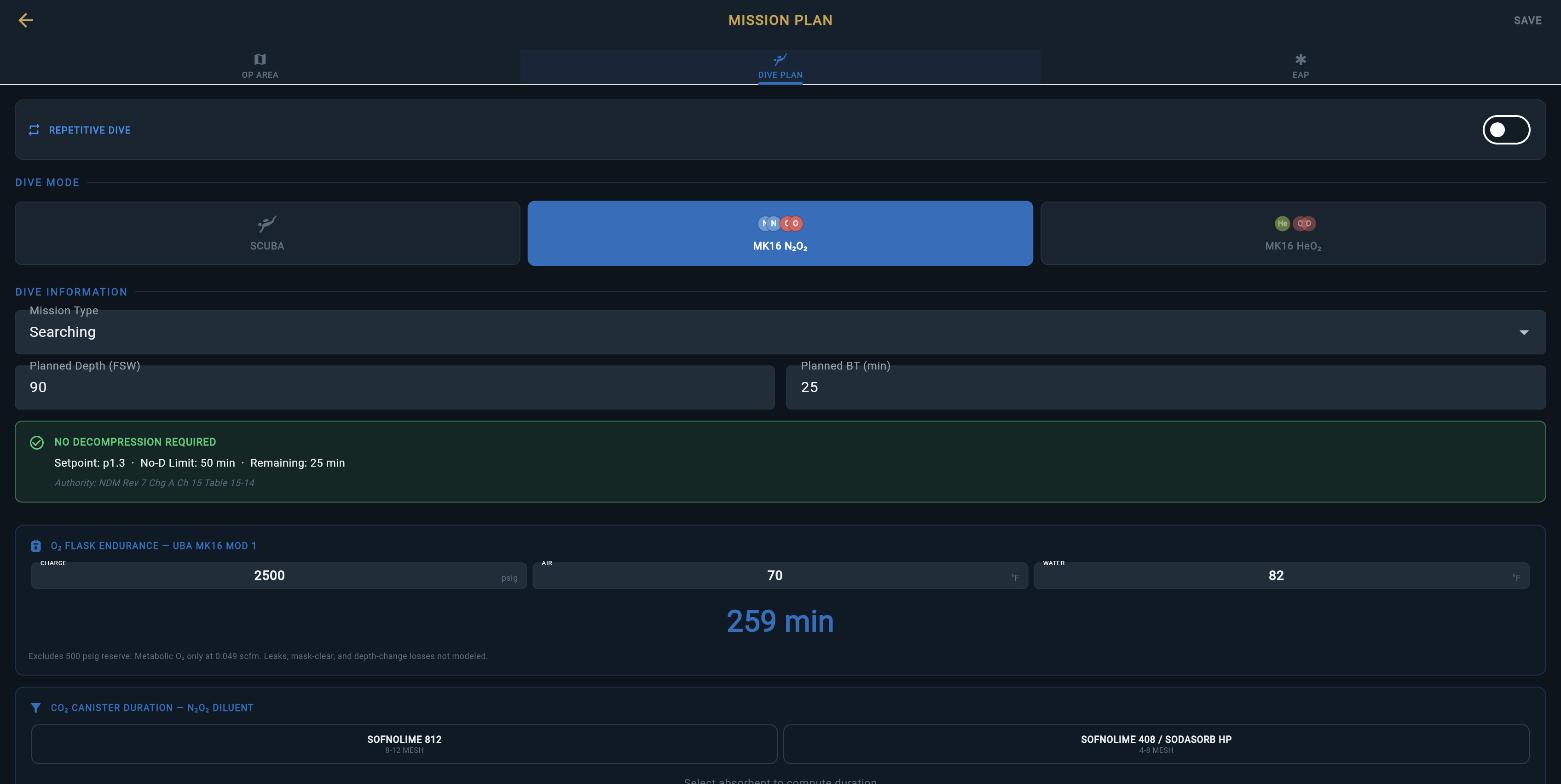
A 90-foot, 25-minute MK 16 plan: verdict, endurance, and canister duration update as values change
DiveSupUnclassified
Feature · Dive Planning
Operating area on a real map
- Dive site pinned on the chart, with maximum depth on the pin card.
- Supervisor, date, local and Zulu time captured in the plan header; Zulu converts automatically.
- Forecast and navigate actions sit on the map: pull the marine forecast for the pin, or hand the position to navigation.
- The pin drives everything downstream: conditions checks run for this position, and the evacuation planner measures every chamber and hospital from it.
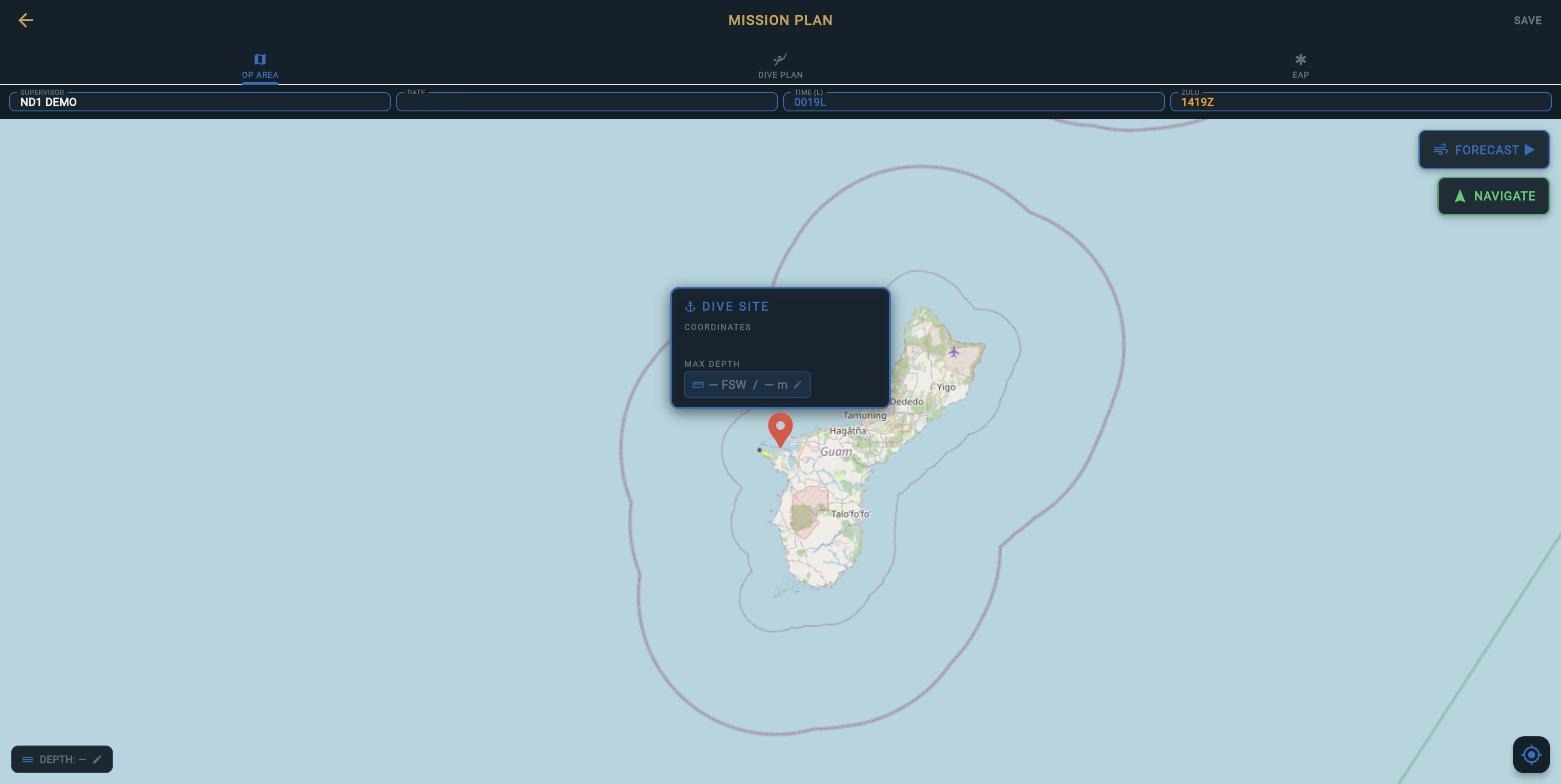
Operating area tab: dive site pin at island scale, depth on the pin card
DiveSupUnclassified
Feature · Evacuation Planning
The emergency action plan is a map, not a memo
- 104 facilities across the Indo-Pacific area of responsibility, chambers and hospitals, sorted by distance from the dive site pin.
- Filters that match the decision: military or civilian, 24-hour, dive medicine capable.
- Reach rings on the map: one-hour and six-hour rings by helicopter or surface transport, tied to the chamber-level requirement.
- Chamber requirement computed from the dive profile per the manual's Table 15-4, shown as the level chip the plan must satisfy.
- The plan form enforces doctrine: primary and secondary chamber and medical evacuation must be designated before every dive evolution, with the manual paragraph quoted on screen.
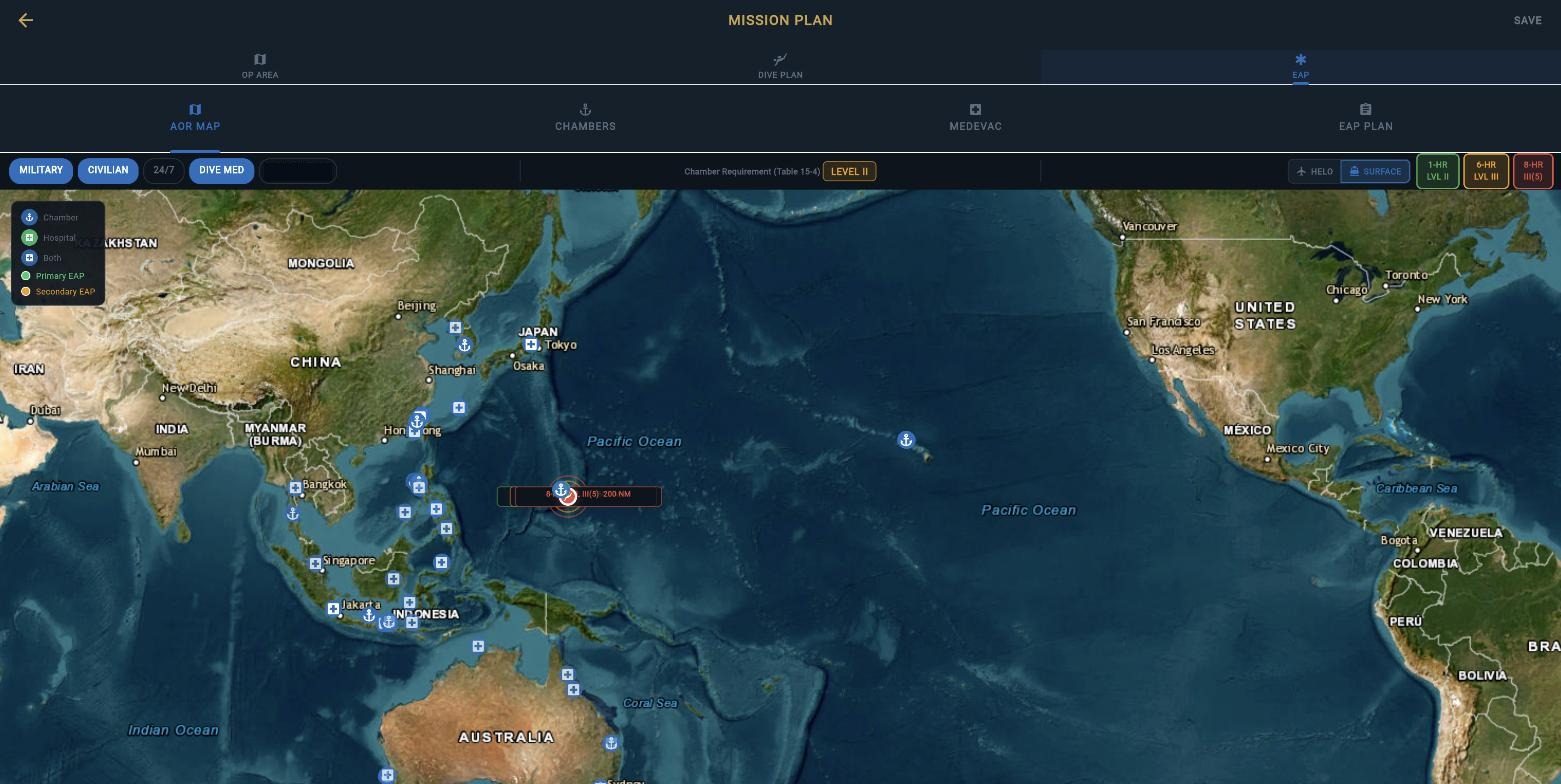
Area-of-responsibility map: facility markers, reach rings, and the required chamber level
DiveSupUnclassified
Feature · Conditions
Live go / no-go from real sources
- Small craft advisory from the National Weather Service office for the operating area.
- Lightning within 10 nautical miles from live strike networks, with the 30-minute hold rule cited.
- Visibility and sea state from marine forecast feeds, checked against set minimums.
- A no-go is a hard banner, and proceeding anyway requires a documented bypass that lands in the dive record.
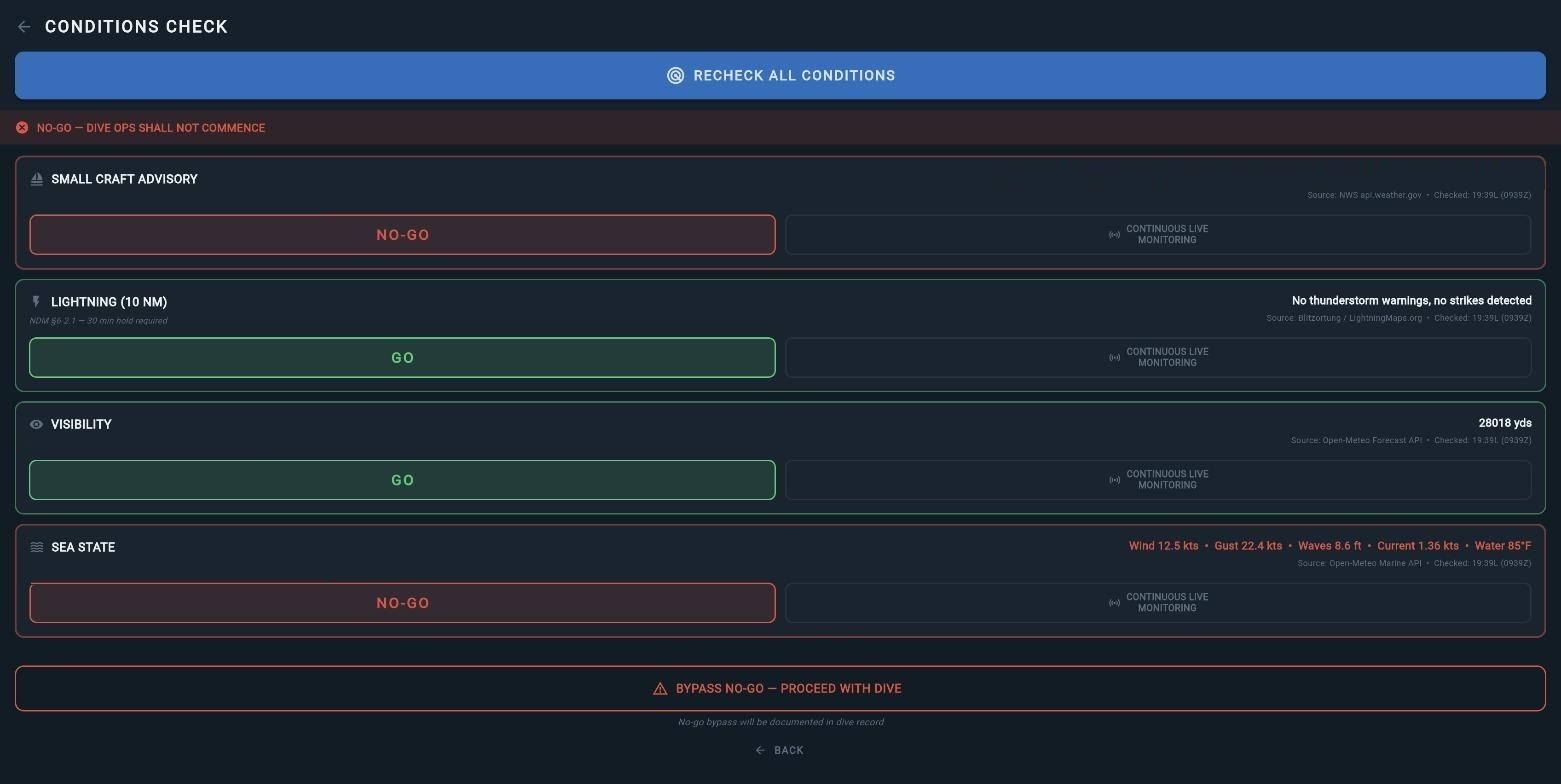
Live conditions check, each row shows its source and time checked
DiveSupUnclassified
Feature · Admin
Notifications and pre-dive paperwork, tracked
- Standing notification list is held in the app, each item tracked done or outstanding.
- Dive plan text to the command duty officer generated and sent from the same screen.
- Deliberate Risk Assessment (DD Form 2977) auto-generated from the dive plan data.
- Sailing list generated server-side from the roster.
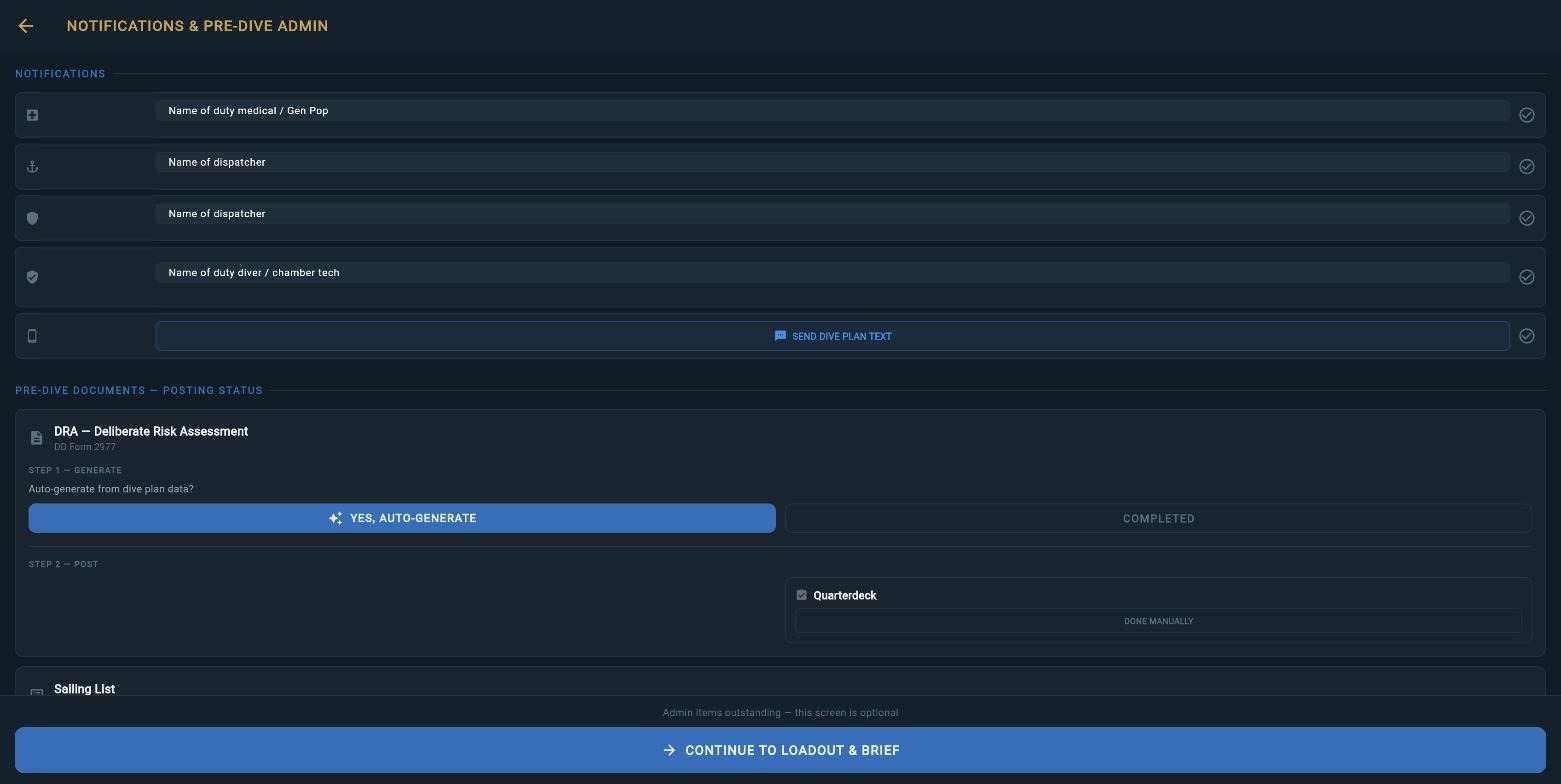
Each notification and document tracks done or outstanding
DiveSupUnclassified
Feature · Brief
A read-aloud brief that fills itself in
- Dive data auto-populated from the plan: mode, setpoint, table and schedule, no-decompression limit from the app's own tables.
- Environmental block filled from the live conditions check, including tide state and next low water.
- Egress plan: duty recompression chamber and backup chamber for the operating area.
- 41 briefing items tracked so the supervisor knows what has been read and acknowledged.
- Emergency procedures and line-pull signals are mode-aware: a rebreather brief covers rebreather casualties.
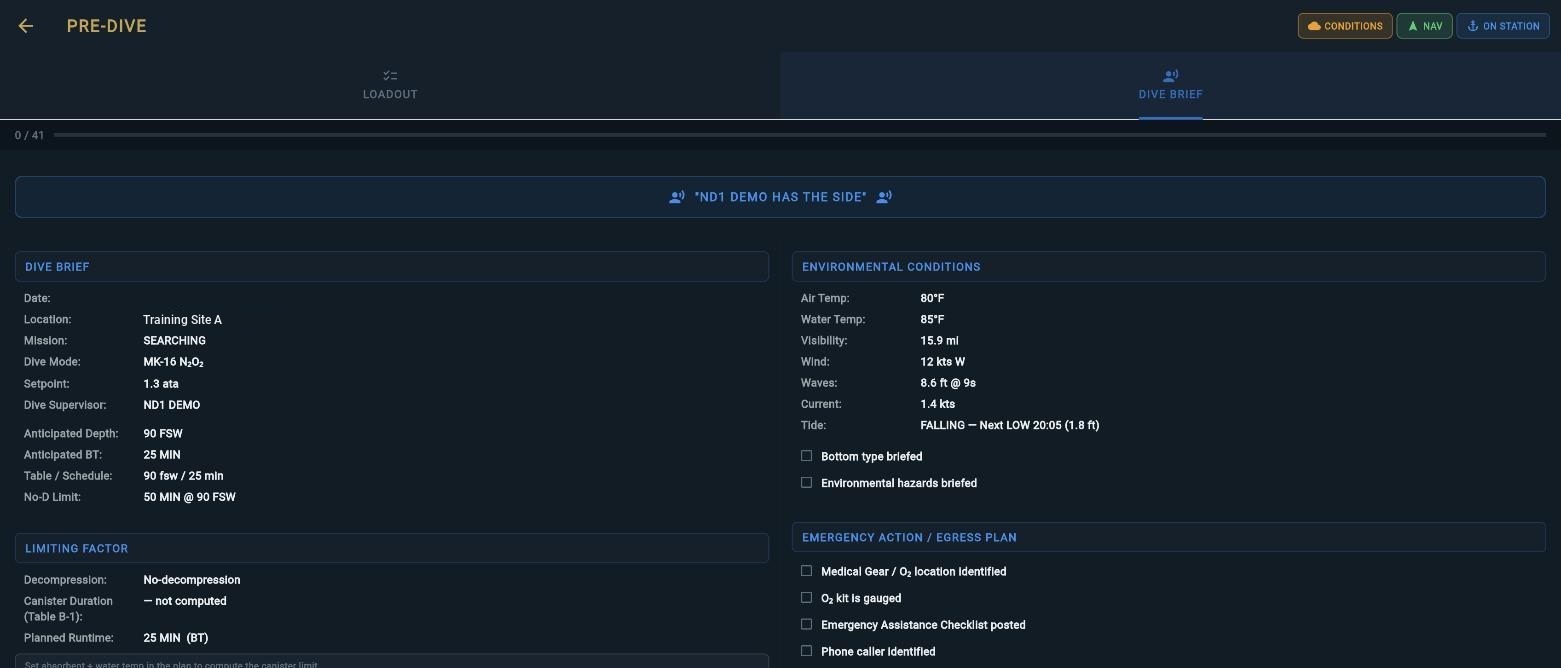
Brief for a 90-foot, 25-minute MK 16 dive with live environmental data
DiveSupUnclassified
Feature · Equipment
Loadout and pre-dive checks, per diver
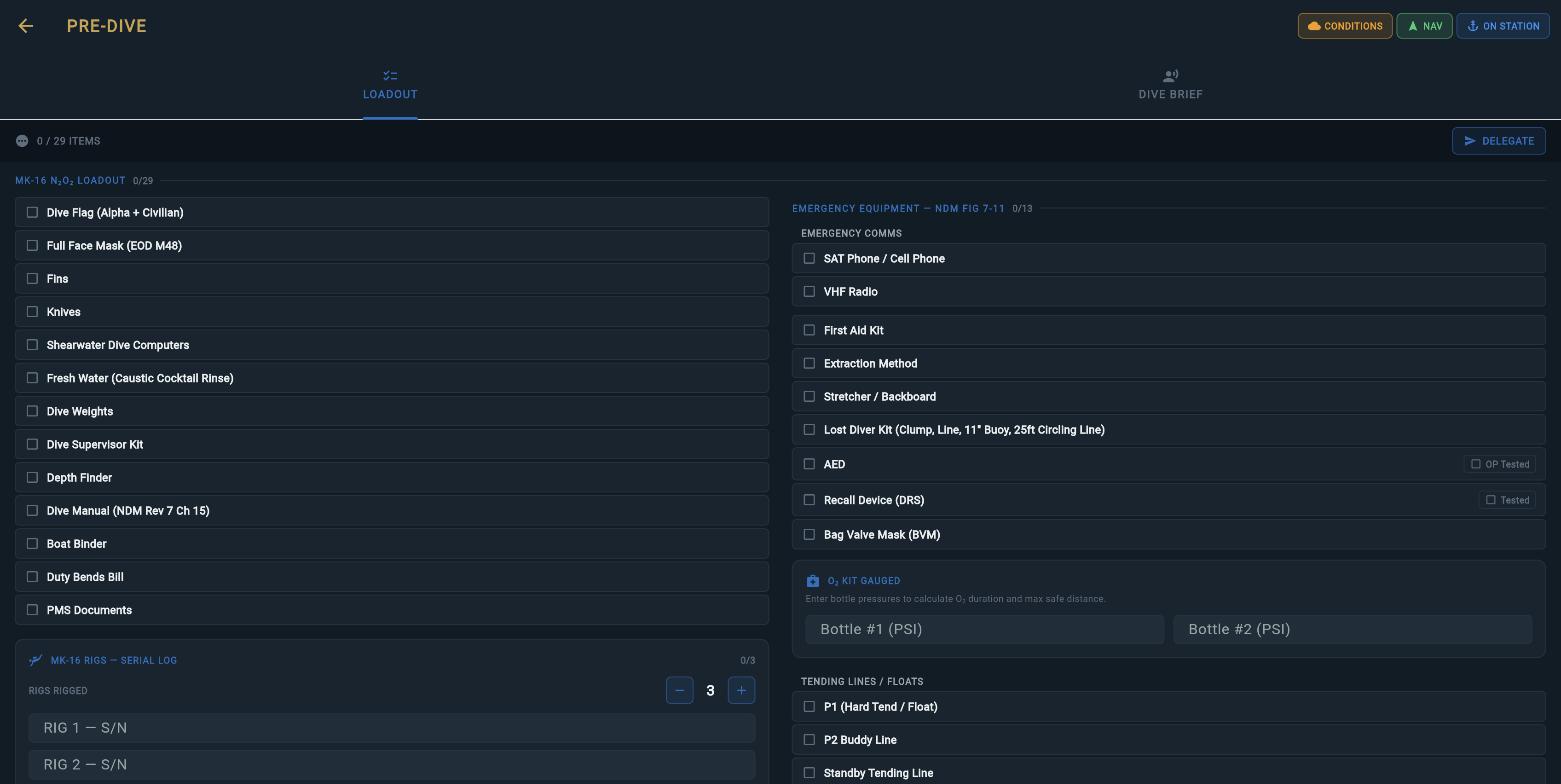
Mode-aware loadout plus emergency equipment per the Navy Diving Manual figure 7-11
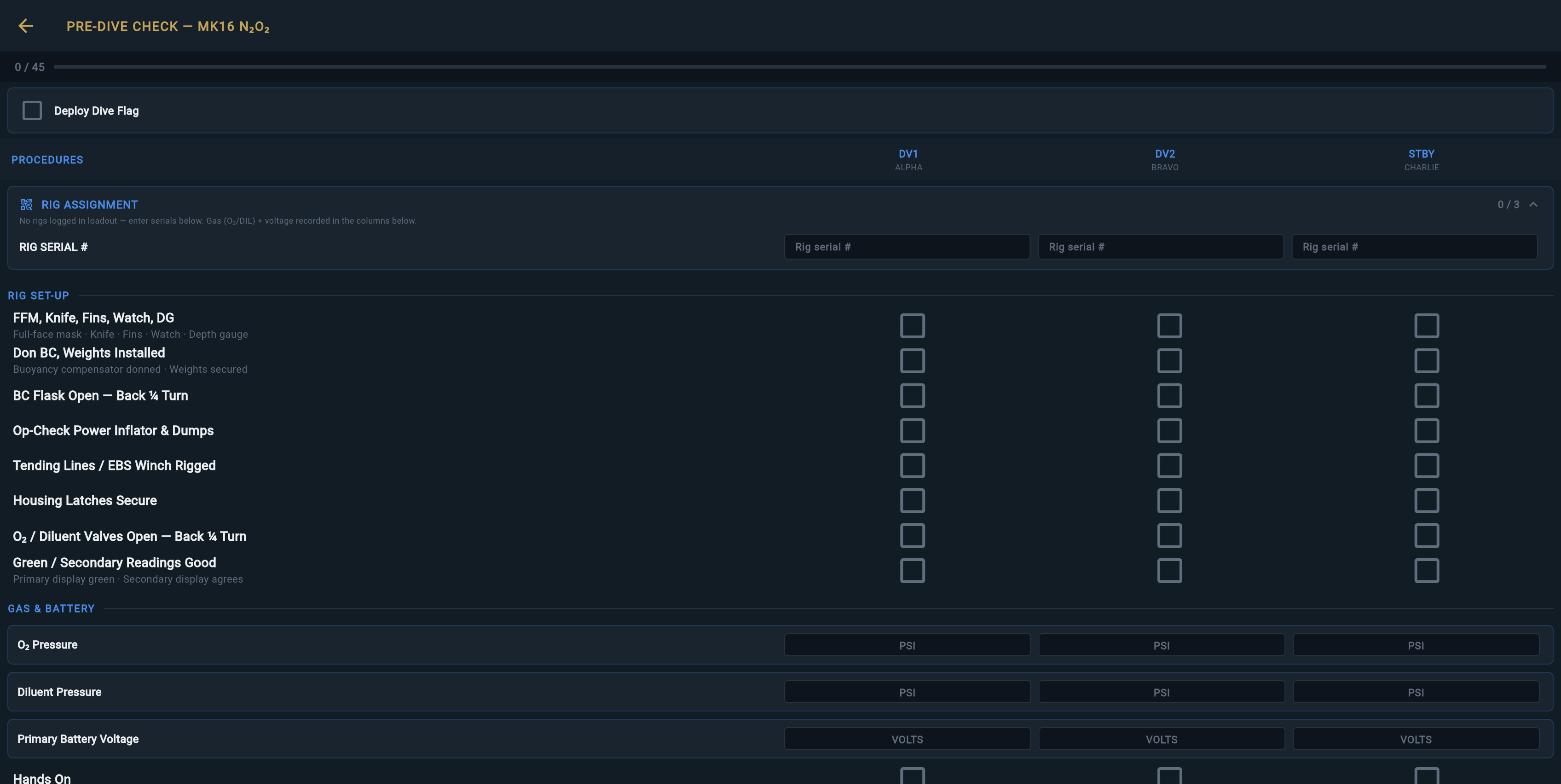
Rig setup steps with gas pressures and battery voltage recorded per diver
DiveSupUnclassified
Feature · After the Dive
Debrief, casualty handoff, and records
- Dive record PDF mirrors the manual's record sheets, including the MK 16 rig block: setpoint, diluent, absorbent, scrubber time.
- Casualty handoff is button-first: status, treatments given, next intervention, concerns, with supervisor contact on the output.
- Post-dive synopsis structures diagnosis, course of action, and further considerations, and auto-carries treatments already given.
- End-of-operations message to the command duty officer carries the dive summary, including rebreather data.
- Reference library on board: supervisor's guide, checklists, and a worldwide recompression chamber directory, searchable by country.
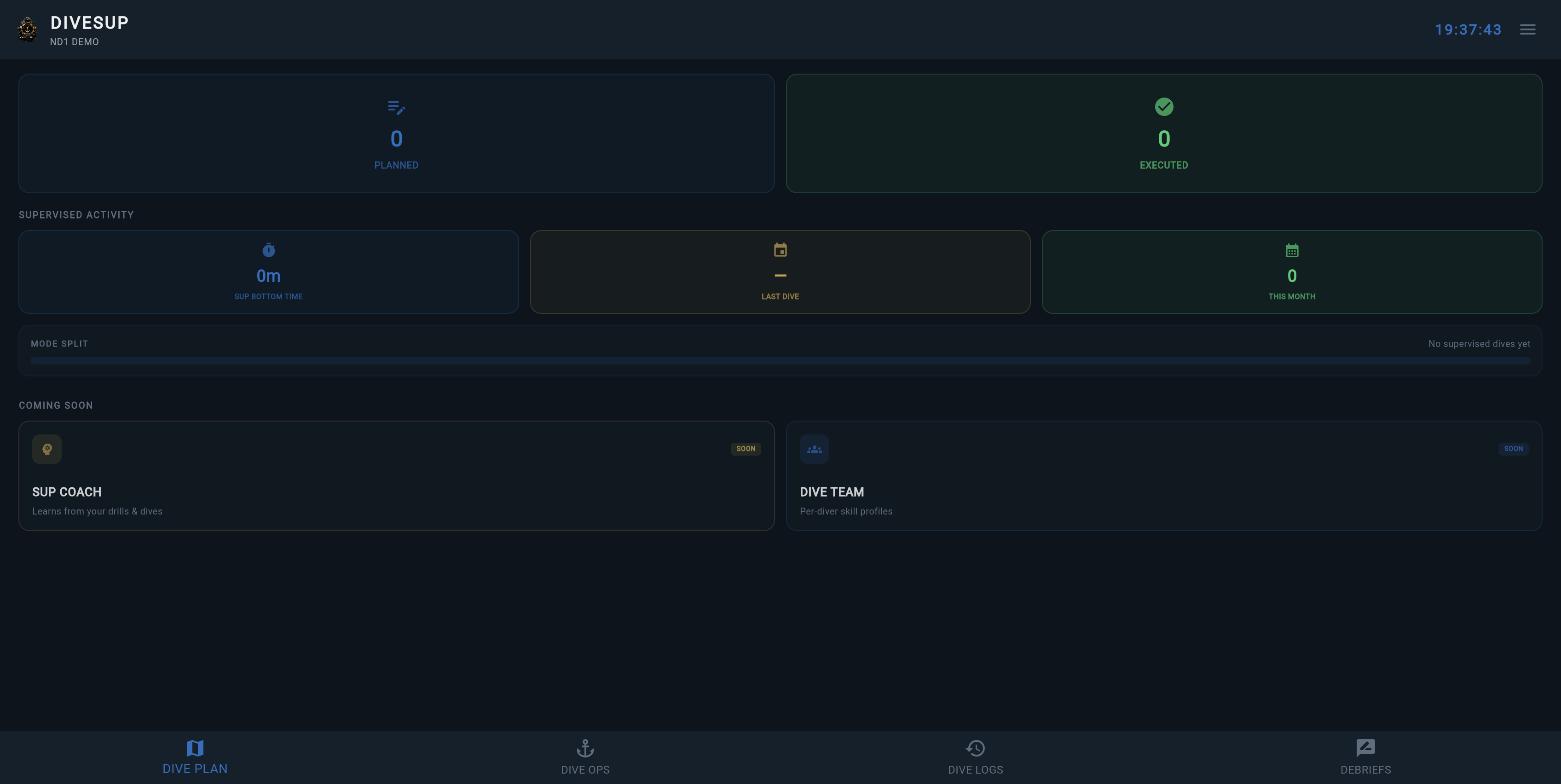
Supervised activity rolls up on the home dashboard
DiveSupUnclassified
Feature · Menu Toolbox
Run Watches: a drill trainer built in
- The menu carries four tools: Run Watches, Reference, Settings, and First-Time Setup for command information and team.
- Run Watches is practice mode. A dry-run dive in real time: the supervisor tracks descent and ascent, jumps past dead waits, and drives every mark. Nothing writes to the logs.
- A scripted casualty deck, graded level 1 through 4: caustic cocktail, rig malfunction with hypoxia, arterial gas embolism on fast ascent, trapped diver, lost diver, delays deeper than 50 feet on decompression dives.
- Blind mode withholds the scenario, so the watch team has to diagnose from the symptoms, the way a real casualty presents.
- Free-form mode simply runs watches on a planned profile for repetitions.
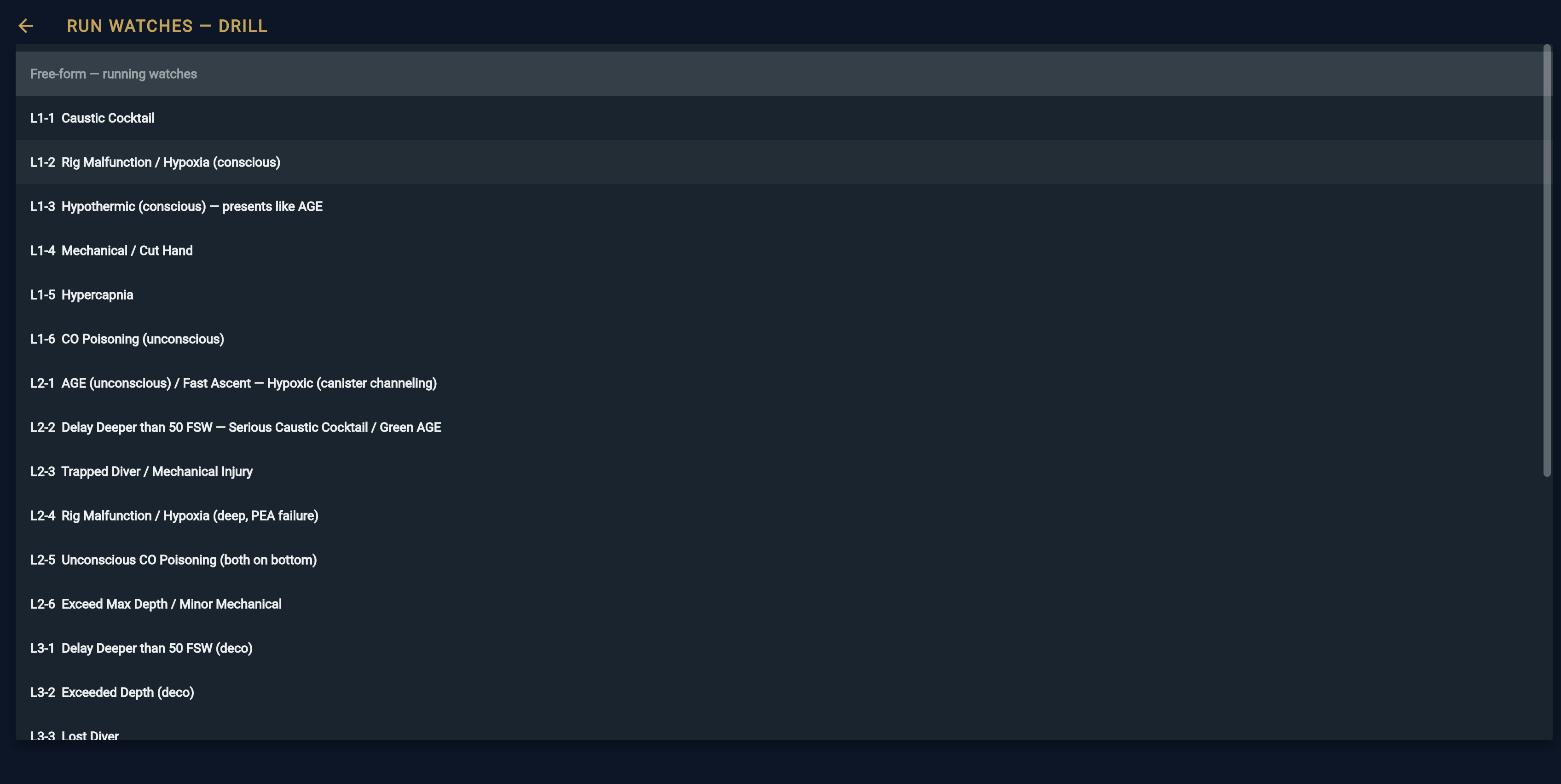
The scripted scenario deck, difficulty-graded casualty drills for the watch team
DiveSupUnclassified
Feature · Menu Toolbox
Reference: the binder, searchable
- Ten reference tabs: air and MK 16 no-decompression limits, shallow water, repetitive dive, ascent rules, line-pull signals, contacts, chamber directory, document library, and radio frequencies.
- Tables are manual-verbatim with the source printed on the table: Navy Diving Manual Rev 7 Chg A, Table 9-7 and Chapter 15.
- Standing emergency contacts preloaded: Divers Alert Network and the supervisor of diving mishap line.
- Chamber directory: worldwide recompression chambers searchable by country, with a currency warning built into the header.
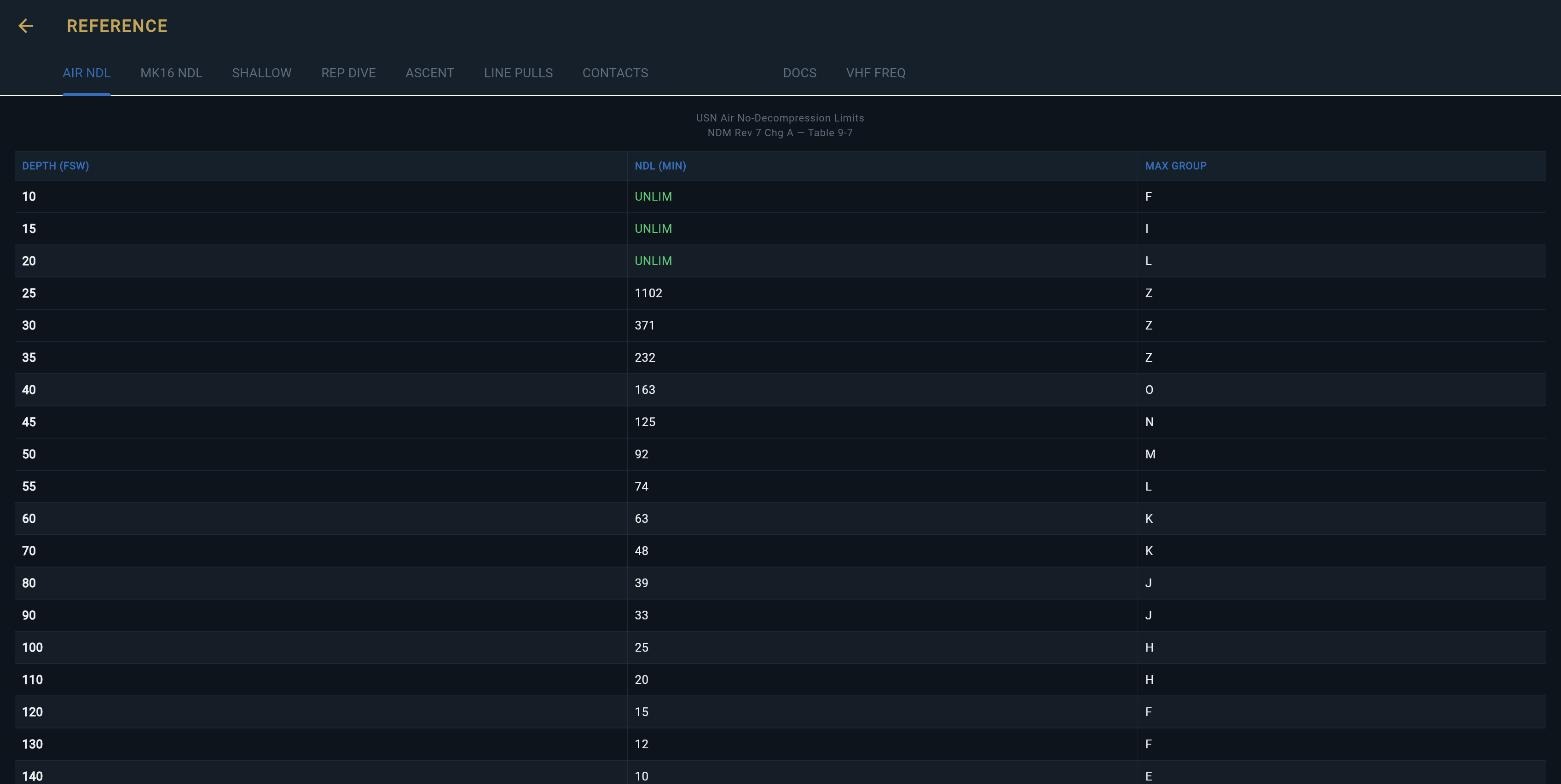
No-decompression limits with the manual citation printed on the table
DiveSupUnclassified
Walkthrough
Sign-on to pre-dive checks
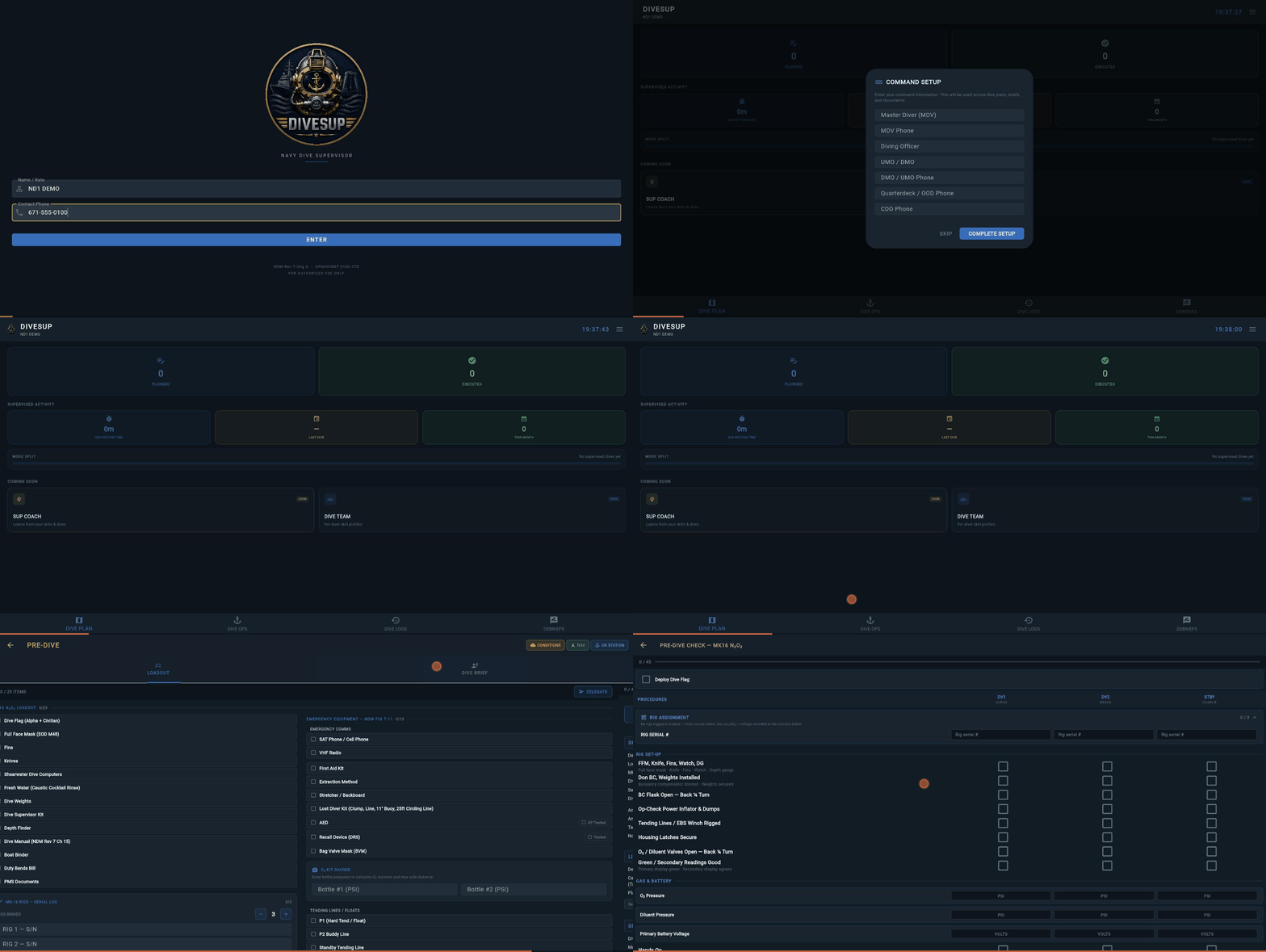
Recorded against the demonstration instance: sign-on, first-time command setup, home dashboard, loadout, and pre-dive checks
DiveSupUnclassified